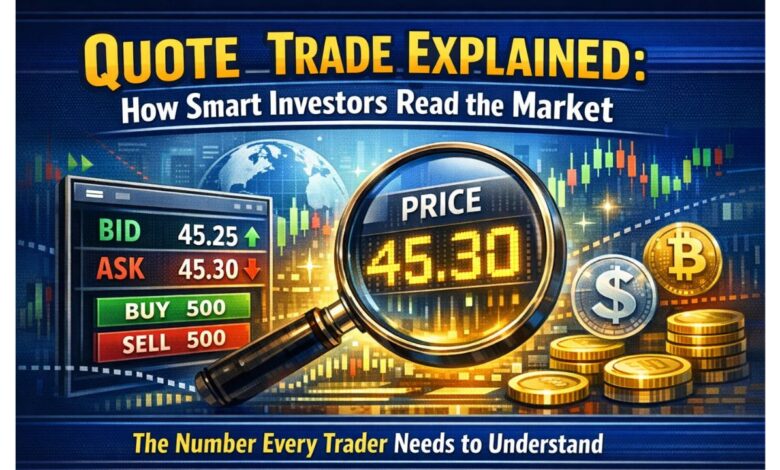
Quote Trade Explained: How Smart Investors Read the Market
Introduction: The Number Every Trader Needs to Understand
Most people think trading is about picking the right stock or crypto asset. But here’s the thing — before anyone places a single buy or sell order, there’s one thing they need to look at first: the quote. Understanding a quote trade is like learning to read a road sign before getting on the highway. Without it, traders are essentially driving blind.
A quote in trading refers to the price at which an asset was last traded or the price at which it can currently be bought or sold. It sounds simple, but there’s a lot packed into that one little number. From stocks to forex to cryptocurrencies, every single transaction begins with reading a quote.
This guide is for anyone — whether someone is just getting started or has been in the markets for a while — who wants to understand how quotes work, why they matter, and how mastering quote trade concepts leads to smarter, more confident trading decisions.
What Is a Quote in Trading?
At its core, a quote is a snapshot of the market’s current opinion on the value of an asset. When someone checks the price of a stock or cryptocurrency, they’re looking at a quote. But that price isn’t fixed — it updates in real time with every new transaction that occurs in the market.
Here’s where people sometimes get confused: a quote is not always the same as the market price. The market price is typically the last price at which a trade was executed. The quote, on the other hand, includes both the price someone is willing to buy at (bid) and the price someone is willing to sell at (ask). These two numbers are constantly shifting as buyers and sellers interact.
In a business context, a “quote” often means a price estimate given by a vendor. In financial markets, however, the term carries a much more precise and dynamic meaning. A quote trade happens the moment someone acts on those quoted prices — turning a number on a screen into a real, executed transaction.
Key Components of a Trade Quote
Reading a quote trade properly means understanding what each piece of information represents. Here’s a breakdown of the essential components:
Bid Price
The bid price is the highest price a buyer is currently willing to pay for a security. Think of it as demand in action — it reflects how much the market values an asset from the buyer’s side.
Ask Price
The ask price is the lowest price at which a seller is willing to sell. It represents the supply side of the equation. Any quote trade can only happen when a buyer’s bid meets a seller’s ask.
Bid-Ask Spread
The bid-ask spread is the difference between the bid and ask prices. This gap is essentially pocketed by the broker or market specialist handling the transaction. A narrow spread usually signals a highly liquid market, while a wide spread suggests lower liquidity or higher uncertainty.
Last Price
The last price is the most recent price at which a trade was completed. This is what most people see on financial news tickers — but it’s a historical snapshot, not necessarily the current executable price.
Volume
Volume tells traders how many shares, units, or contracts have been traded over a given period. High volume often confirms the strength of a price move, while low volume can signal weak conviction in the market.
Open, High, Low, Close (OHLC)
These four data points together paint a picture of how an asset behaved during a trading session. The open is where it started, the high and low define the range, and the close is where it ended up. Together, they form the foundation of technical analysis.
Types of Trade Quotes
Not all quotes are created equal. Depending on the platform and the level of access a trader has, they may encounter different types of trade quotes.
Level 1 Quotes
Level 1 quotes are the most basic and commonly used. They show the last price, the bid, and the offer (ask). This is typically what retail investors see on standard brokerage platforms. For most buy-and-hold investors, Level 1 is more than sufficient.
Level 2 Quotes
Level 2 quotes go deeper. They show the full consolidated limit order book — all the active bids and offers at various price levels, along with which market makers or exchanges are posting them. This is incredibly valuable for active day traders who need to gauge where buying and selling pressure is building up.
Level 3 Quotes
Level 3 is specialized territory. It’s a data feed typically reserved for broker-dealers and professional market participants with full order book access. Most retail traders won’t ever interact with Level 3 quotes directly.
Firm Quotes vs. Indicative Quotes
A firm quote is a legally binding price that a market maker commits to honor. If someone acts on a firm quote, the market maker must follow through. An indicative quote, on the other hand, is informational only — it gives a general sense of where the market is but doesn’t guarantee execution at that price. Knowing the difference can save traders from some unpleasant surprises.
How to Read a Trade Quote
Reading a quote trade might feel overwhelming at first, but it becomes second nature with practice. Here’s how to approach it:
Start with the ticker symbol. Every publicly traded asset has a unique identifier — AAPL for Apple, BTC for Bitcoin, EUR/USD for the euro-dollar pair. The ticker is the first thing to locate.
Look at the bid and ask together. Don’t just glance at the last price. The bid-ask spread tells a trader the real cost of entering and exiting a position. A wide spread means higher implicit transaction costs.
Check the volume. Is today’s trading volume higher or lower than average? Heavy volume adds credibility to a price move; thin volume often means the move isn’t well-supported.
Use price change data. Most platforms show how much an asset has moved, both in dollar terms and percentage terms, compared to the previous close. This gives quick context for whether the market is trending or flat.
Assess market depth with Level 2 data. For active traders, Level 2 data reveals where large clusters of buy or sell orders are sitting. This can hint at potential support and resistance levels before they become obvious.
Role of Quotes in Trading Strategy
Quotes aren’t just informational — they’re strategic. Here’s how serious traders actually use them:
Timing Entries and Exits
By watching real-time quote movements, traders can spot moments of momentum or exhaustion. A rapidly climbing ask price, for example, might indicate strong buying pressure that’s about to break a resistance level.
Using Spread as a Liquidity Gauge
The bid-ask spread is one of the most underrated indicators of market health. In highly liquid markets like major forex pairs or large-cap stocks, spreads are razor-thin. In thinly traded assets — including many smaller cryptocurrencies — spreads can be enormous, making quote trade expensive even before factoring in commissions.
This is especially relevant in the world of dark pool DEX trading. A dark pool DEX (decentralized exchange) operates with limited transparency, meaning quotes may not reflect the true supply and demand picture. Traders using dark pool DEX platforms for large transactions often do so precisely to avoid moving the visible market — but this also means the public quote may not tell the full story.
Real-Time Accuracy Matters — A Lot
Inaccurate or delayed quotes can cause significant financial losses for traders who depend on real-time data. In fast-moving markets, even a few seconds of delay can mean the difference between a profitable trade and a painful one. This is why professional traders invest heavily in low-latency data feeds and direct market access.
Quote-Driven vs. Order-Driven Markets
Some markets are quote-driven — meaning prices are set by market makers who continuously post bids and asks. Others are order-driven, where prices emerge from a centralized order book matching buyers and sellers directly. Most modern markets blend both systems.
Quote Trade Across Different Asset Classes
The concept of a quote trade applies across virtually every financial market, though the mechanics vary slightly depending on the asset class.
Stocks
In equity markets, quotes are generated on exchanges like the NYSE or NASDAQ. Real-time Level 1 and Level 2 data are widely available to retail traders through brokerage platforms.
Forex
Currency pairs are quoted in terms of how much of the quote currency is needed to buy one unit of the base currency. For example, in EUR/USD, the euro is the base and the dollar is the quote. Forex markets are highly liquid, resulting in very tight bid-ask spreads.
Commodities
Commodity quotes can appear in both spot and futures markets. Futures contracts have their own separate quotes for each expiration date, which adds complexity but also opportunity for sophisticated traders.
Bonds
Bond quotes work a bit differently — they’re often expressed as a percentage of face value or in terms of yield rather than a straightforward dollar price. A bond trading at 98 means it’s available for 98% of its par value.
Cryptocurrencies
Crypto markets operate 24/7, which means quote trade in digital assets never sleeps. This constant activity creates unique opportunities — and unique risks. One growing phenomenon is block execution crypto trading, where large institutional buyers or sellers execute massive crypto orders in a single transaction to minimize slippage. Block execution crypto strategies are designed to move large positions without dramatically impacting the publicly visible quote. It’s similar in concept to institutional block trading in equities, adapted for the decentralized and round-the-clock nature of crypto markets.
Technology and Quote Data
The way quotes are delivered has evolved dramatically over the decades.
From Ticker Tape to Digital Feeds
Not long ago, traders received price updates via physical ticker tape — narrow strips of paper with abbreviated ticker symbols and prices. Today, quote data streams digitally at millisecond speeds across global networks.
Real-Time vs. Delayed Quotes
Many free platforms offer quotes with a 15–20 minute delay. For long-term investors, this is often fine. For active traders, real-time data is non-negotiable. Delayed quotes in volatile markets are essentially useless for execution purposes.
Platforms and APIs
Tools like TradingView and Bloomberg have become standard for visualizing quote data. For more technically inclined traders and developers, quote data APIs allow custom applications to pull live market prices and build automated strategies around them.
Algorithmic Trading
Quote-driven automation has become a dominant force in modern markets. Algorithms scan thousands of quote changes per second, executing trades in microseconds based on pre-programmed rules. For retail traders, understanding how these systems interact with quotes helps them navigate markets that are no longer purely human-driven.
Regulatory Oversight
To maintain fairness, regulators like the SEC require that quote data meet specific standards of accuracy and timeliness. Exchanges and data providers are held to strict rules about how quotes are displayed and distributed — ensuring that all participants have access to reliable market information.
Common Mistakes Traders Make with Quotes
Even experienced traders fall into quote-related traps. Here are the most common ones to watch out for:
Relying on delayed quotes in fast markets. In a volatile session, a 15-minute-old quote is ancient history. Always verify that data is live before acting.
Ignoring the bid-ask spread on low-liquidity assets. A 5% spread means a trader is already down 5% the moment they enter. This is a hidden cost that catches many newcomers off guard.
Confusing the last price with the executable price. The last price shows where a trade happened — not where the next one will. Always check the current bid and ask before placing an order.
Overlooking market depth signals. A thin order book can allow a single large order to dramatically shift a quote. Watching Level 2 data helps traders anticipate these moves before they happen.
Conclusion: Quotes Are the Language of the Market
Every trade, in every market, in every corner of the world starts with a quote. Understanding what those numbers mean — and how to use them — is one of the most fundamental skills any trader can develop.
From reading a basic Level 1 quote on a brokerage platform to understanding how block execution crypto strategies minimize market impact, or how dark pool DEX platforms operate outside the public order book, the quote trade ecosystem is rich and layered. Mastering it doesn’t happen overnight, but the fundamentals are accessible to anyone willing to put in the effort.
The best next step? Open a paper trading account and start reading quotes in real time. Watch how bid and ask prices shift. Notice how the spread changes during high-volume versus low-volume periods. Pay attention to Level 2 data and see how order flow builds before a big move.
The market speaks in quotes. Learning that language is how traders stop guessing — and start knowing.
Frequently Asked Questions
What is a quote in stock trading?
A quote in stock trading refers to the current bid and ask prices for a stock, along with the last traded price. It gives traders a snapshot of what buyers are willing to pay and what sellers are willing to accept at any given moment.
What is the difference between bid and ask price?
The bid price is the highest amount a buyer is willing to pay for an asset. The ask price is the lowest amount a seller will accept. The difference between the two is called the bid-ask spread.
What is a bid-ask spread?
The bid-ask spread is the gap between the bid and ask prices. It represents the transaction cost built into a quote trade and is typically earned by the broker or market maker facilitating the trade.
What are Level 1 and Level 2 quotes?
Level 1 quotes show basic information — last price, bid, and ask. Level 2 quotes provide a deeper view of the market, showing all active buy and sell orders at various price levels from different market participants.
How do I read a stock market quote?
Start with the ticker symbol, then check the bid and ask prices. Note the bid-ask spread, the last traded price, and the volume. For more detail, look at OHLC data and, if available, Level 2 order book information.
What is a firm quote vs. an indicative quote?
A firm quote is a binding price commitment from a market maker. An indicative quote is informational only and does not guarantee execution at that price.
Also Read: Management Guide EWMagWork: Comprehensive Insights into Workplace Management EWMagWork